“Malaria has had so many bad effects in the community,” says Alhajie K. Kamara. A peer supervisor for community health workers near Barmoi Munu and Gbalan Thallan clinics in Kambia District, Sierra Leone, Alhajie also provides care to families in his own community. “Children will miss school. Parents cannot go to their farms or look after their businesses if a child gets sick,” he explains.

Community health workers in Kambia district attend immunization training.
In Sierra Leone, malaria is the leading cause of death for children under five, and rural and remote communities bear a disproportionate share of the burden. The Ministry of Health has declared the country’s high maternal and child mortality rates a national emergency, and alongside partners including Last Mile Health, they’re leveraging the country’s newly integrated and professionalized cadre of community health workers to reduce illness and death from malaria. Already, they play a vital role in community education, teaching families about how children contract malaria and helping them reduce environmental risks by minimizing standing water near homes, shutting windows at dusk, and sleeping under insecticide-treated nets. In hard-to-reach areas, when a child shows signs of malaria, community health workers can screen for, diagnose, and treat the illness immediately—and for complex cases, they refer children to health facilities for advanced treatment.
Healthy practices and quick, accessible care are critical in preventing illness and death from malaria. But even with these measures in place, the number of children who suffer from the disease remains unacceptably high. The Ministry of Health’s goal is zero deaths from malaria, and a new intervention will bring that goal closer: a vaccine that reduces the incidence and severity of the disease.
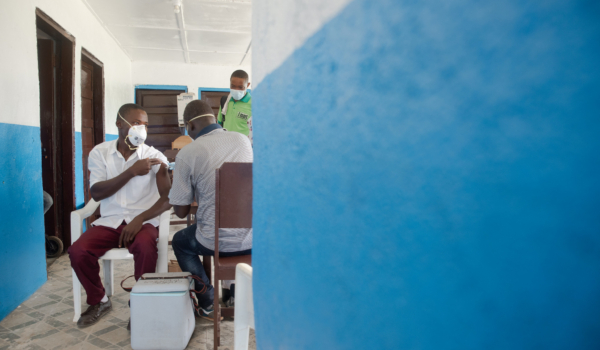
The Ministry has successfully integrated the malaria vaccine into Sierra Leone’s routine childhood immunization schedule, with more than 20,000 children in Kambia District alone receiving the first dose. But a key challenge remains: as the vaccine requires four doses—meaning four visits to the health facility—many children do not receive all follow-up doses, becoming “defaulters” without the protection a full course of the vaccine can offer. The Ministry of Health, with support from technical partners including Last Mile Health, is working to ensure that the full dosage of the malaria vaccine reaches children in rural and remote communities. The ultimate goal: every family in Sierra Leone will have access to all doses of the vaccine, and no child will die from a preventable, treatable disease.

An immunization training at a clinic in Kambia.
Quality training for quality care
For families in rural and remote communities in Sierra Leone, reaching the health facility for vaccination means traveling for hours on narrow footpaths, rough roads, and flood-vulnerable bridges. Long distances, costly river crossings, rainy-season travel disruptions, and limited contact with health workers make it difficult to reach the facility—and four separate doses of the malaria vaccine require four arduous trips. These challenges are especially acute in rural and remote communities like many of those in Kambia District, where Last Mile Health works side by side with district-level Ministry of Health staff on the implementation of the National Community Health Worker Program.
In early 2025, Last Mile Health began working alongside the Ministry to build a strong foundation for the vaccine’s official launch in Kambia. We worked together to establish a framework outlining community health workers’ role in supporting malaria vaccination, and then developed a national immunization training curriculum with a focus on malaria vaccine delivery. After pre-tests, we launched the curriculum in Kambia District. Together, we trained the district-level staff who would facilitate community health workers’ training: a partnered approach that laid the groundwork for future in-country training the Ministry can own without external support. We developed supplementary job aids for community health workers, giving them a practical, easy-to-reference tool to support correct and consistent service delivery. We also designed a defaulter tracking tool to strengthen their ability to identify and follow up with children who have missed scheduled vaccinations, supporting improved completion.

A facilitator leads immunization training.
With support from district-level staff and community leaders, Last Mile Health and the Ministry of Health delivered training in June 2026, reaching 336 community health workers and supervisors—over 95% of Kambia’s community health workforce. Health facility staff also attended training, setting up a shared and seamless understanding of immunization education, delivery, and follow-up. Participants learned about how the vaccine works, how to educate families, how to identify and refer eligible children, and how and when to follow up to ensure children complete all four doses. Trainings were interactive, with participants completing practical exercises, roleplays, and experience sharing. Pre- and post-tests tracked knowledge gains, and a post-training survey gave participants the chance to offer feedback. To ensure long-term retention of knowledge and skills, Last Mile Health and Ministry of Health staff will facilitate monthly supervision and mentorship alongside peer supervisors, as well as regular refresher training.
“In the training, I learned about the malaria vaccine—that it is free and how it works,” says community health worker Santigie Kamara. “I will use this information to reach out to caregivers to take their children to the health facility so that the children can receive the malaria vaccine. I will also plan with my peer supervisor to organize outreach sessions and ensure that children who are defaulters can also receive the malaria vaccine.”
The next step: Bringing malaria vaccines within reach of all children in Sierra Leone

Community health workers complete a roleplay during training.
With training complete, Kambia’s community health workers have returned to their communities, where they are beginning to educate families about the malaria vaccine. They will plan outreach events, work with local leaders to help reach more families, and track children who receive the first dose of the vaccine to ensure they complete all four doses. They’ll attend supervision meetings where Last Mile Health and Ministry staff will accompany supervisors to provide tailored coaching and mentorship as well as collecting regular immunization data.
The malaria vaccine’s rollout—supported by the community health workers’ daily work—is a crucial component of the Ministry of Health’s policies and priorities. Earlier this year, Minister of Health Austin Demby announced a “three zeroes” initiative targeting zero preventable child deaths, zero preventable maternal deaths, and zero zero-dose children. As children begin receiving malaria vaccines in Kambia, we’ll track progress and share data across all levels of the Ministry, identifying successes, challenges, and solutions. In addition to supervision visits at the community level, regular technical working group meetings will provide the opportunity for national-level Ministry staff to review vaccine performance across facilities and districts. Together, these reviews will create a routine feedback loop between community-level implementation and national-level decision-making, ensuring policy and practice align—and improve continuously.
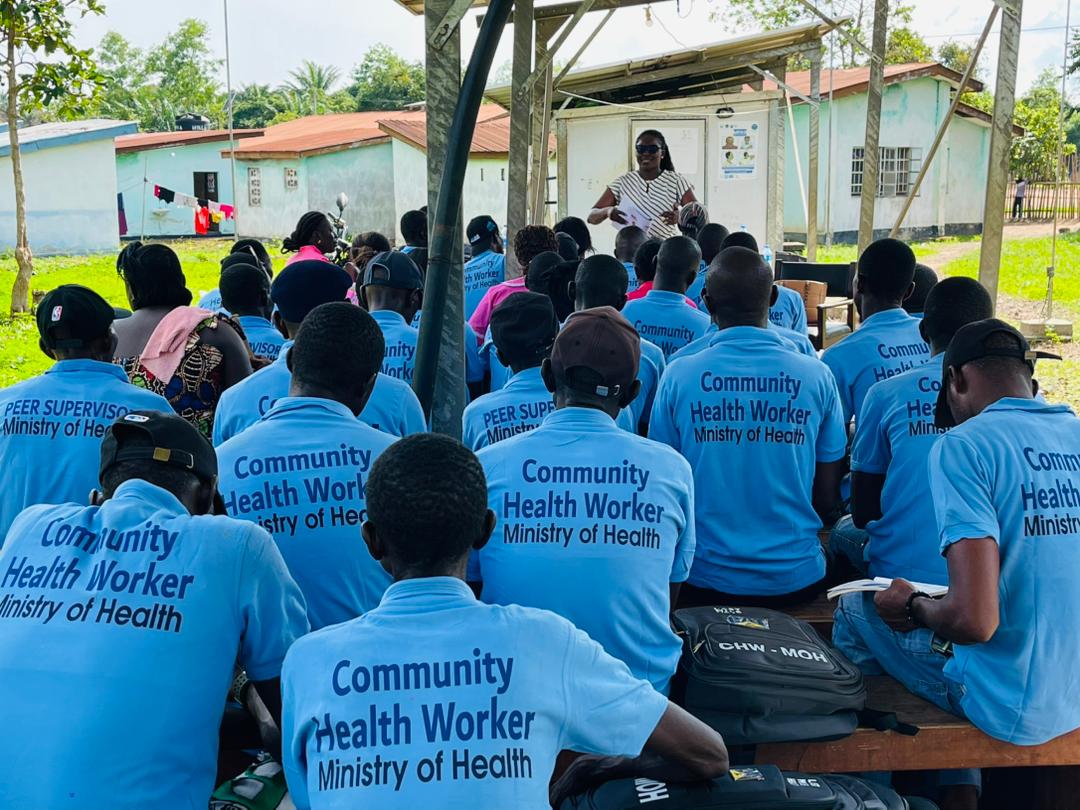
A lecture session during community health workers’ immunization training.
While the Ministry and partners work to improve the vaccine’s delivery across Sierra Leone, the daily work is taking place across thousands of communities like Barmoi Munu, carried out by community health workers like Santigie Kamara. Behind every statistic—fewer missed doses, fewer zero-dose children, and fewer cases of malaria—there will be a child with a healthier, safer future thanks to the efforts of a community health worker.
“The impact I would love to make is to actually change the minds of the people in my communities by giving them the right messages on vaccinations and dispel every rumor and misinformation,” says peer supervisor Alhajie K. Kamara. “I want my action to reduce the number of malaria illnesses in my community by giving them the right information and having more children immunized.”