
Imagine yourself in the shoes of Aynet Edel, a community health worker serving her neighbors in Mirab Abaya woreda, Ethiopia. She is a high-performing community health worker, equipped with consistent training and a tablet to aid her daily work. Still, she may encounter a case that causes her to pause: a young patient presents with symptoms that look like both malaria and pneumonia. She needs guidance to ensure she can treat the child correctly. For Aynet, the margin for error can be the difference between life and death.
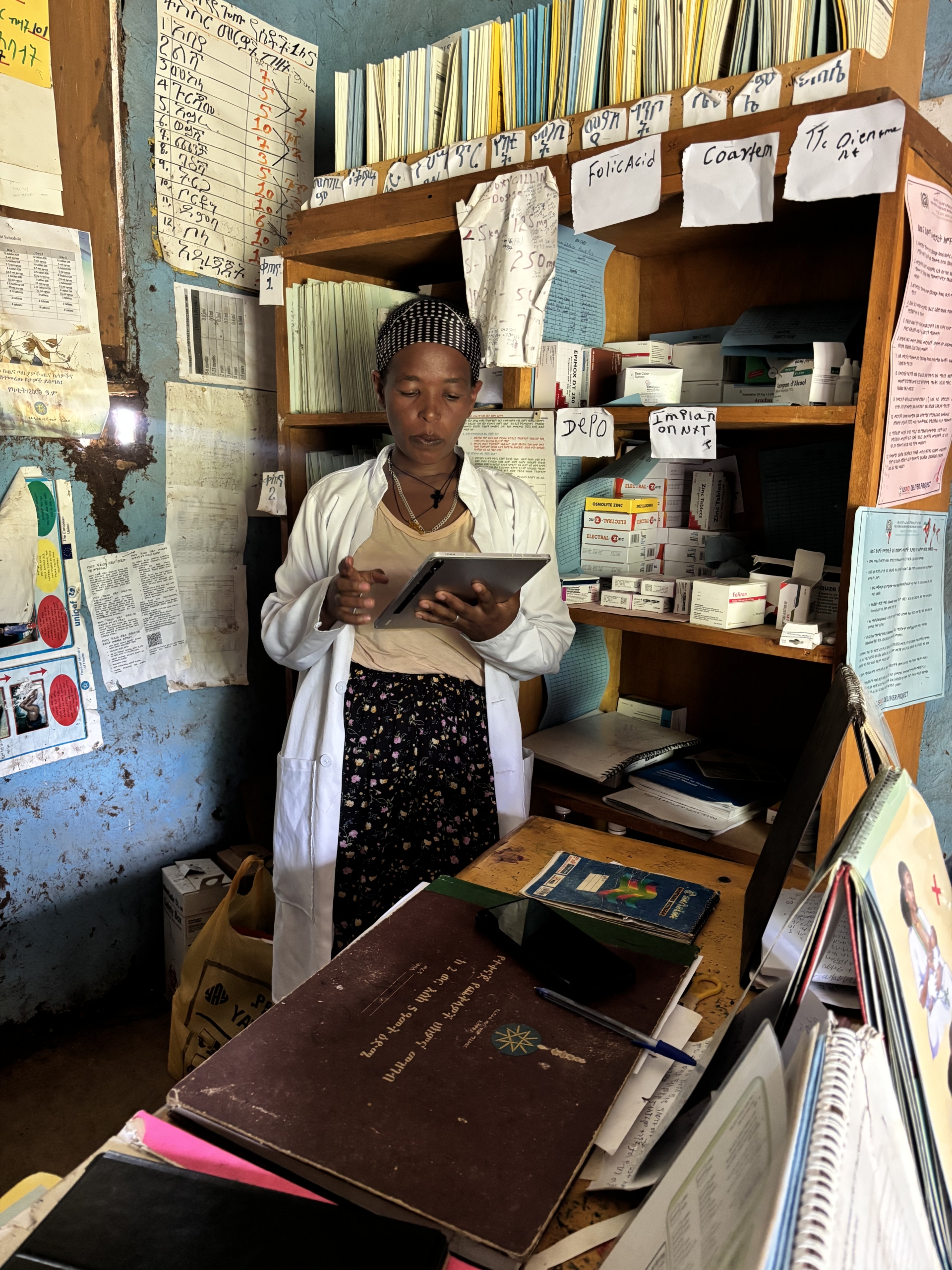
Community health worker Aynet Adalo uses her device to access AI support.
The potential of AI for community health workers is real: it can lighten workloads, close knowledge and skill gaps, and improve effectiveness. But this potential comes with risks. To mitigate these risks, technology must protect the agency, trust, and expertise of community health workers, instead of aiming to replace them.
Last Mile Health approaches AI in service of community health workers. We center people, rather than technology, designing interventions with and for those delivering care. This perspective is grounded in nearly two decades of experience building and strengthening community health systems across Africa, including deep work in designing and rolling out digital health tools and national data systems that strive to serve the needs of those living and working in the world’s most remote contexts.
The opportunity: Bridging gaps through AI
Across Africa, community health workers deliver primary healthcare to millions of families living in rural and remote communities. Often the only point of contact with the formal health system, they traverse long distances, operate in settings with limited or no electricity or connectivity, and make complex clinic decisions at the point of care. They manage multi-step protocols and detailed documentation requirements, using fragmented tools that may lack interconnectivity. Even with regular training and supervision, community health workers face gaps in support as they conduct patient visits far from the nearest health center.
The same logic extends up the system. Supervisors, who mentor and coach community health workers across large catchment areas, are stretched thin. They lack real-time visibility into which community health workers need help, their coaching addresses broader challenges rather than responding to immediate patient needs, and they must balance administrative responsibilities alongside mentorship. At the district level, the challenge manifests in fragmented data, slow trend detection, and heavy planning loads. Every level of the system has real, specific pain points. These points offer opportunities where AI can ease the burden, freeing up health workers themselves to focus on patient care.

Community health worker Fekre Fargo accesses AI support while speaking to a mother and child at the health post.
The potential spans a wider range than is often assumed. Beyond clinical decision support, AI can reduce the hours community health workers spend on long, duplicative forms through voice-to-text documentation. It can deliver adaptive training between supervision visits, tailored to a specific worker’s knowledge gaps. At the district level, it can flag data anomalies in real time, helping detect emerging disease trends, and it can assist supervisors in identifying which health workers need additional support. These uses can help make community health workers more efficient, more effective, and more impactful.
AI is already showing up in the daily work of community health workers, supervisors, and health officials, but unevenly and with serious vulnerabilities. In a recent survey of 200+ community health workers across 12 countries, Community Health Impact Coalition found that 80% of respondents are already using AI tools in their daily work, while 50% have received no or only very brief training, and one in six do not feel confident about when to question or override AI recommendations. These numbers represent the continuation of a troubling and familiar trend: communities in rural and remote settings have historically been the last to benefit from health innovations and among the first to be harmed when tools are designed without them. If AI arrives without investment in local ownership, training, and infrastructure, it will widen the gaps it aims to close.
Our guiding principles on AI
Drawing from our experience partnering with governments to design systems and tools that support community health workers, we have developed an initial set of principles that guide how Last Mile Health thinks about and deploys AI in community health settings. These principles are informed by the history of well-intended digital health tools that could not adapt to the reality of remote contexts as well as those that have been successful. While we expect that the specifics of these principles will evolve as our work does, they are an important start:
- Increase agency: Technology must strengthen frontline health workers’ confidence, not undermine it. It is crucial that community health workers and supervisors maintain agency and authority in decision-making. Strategic AI assistance can provide targeted support that builds from their existing skillset. To ensure this is the reality, we must introduce AI intentionally, orienting community health workers both to its potential and its limitations and encourage them to question and override recommendations that go against their judgment. The goal is a health worker who is equipped with targeted support, but does not have to rely on a machine to do the work.
- Partner and co-design with governments: AI tools built must be built with and for national health systems. That means partnership with Ministries of Health from the start: co-designing tools, grounding them in national protocols, and planning from day one for government ownership. We recognize the tension here: governments at times operate at a slower pace and technology moves fast. With this in mind, we must work intentionally to balance these needs, exploring and refining innovations while deepening government engagement so that speed and ownership work together for lasting impact.
- Design for low-power, offline reality: The communities where Last Mile Health operates often lack reliable electricity or consistent network coverage, and health workers may only be able to access shared or unreliable devices. An AI tool that requires a stable internet connection or a modern smartphone fails where it is most needed. We design for real conditions, grounded in our applied experience.
- Maintain appropriate human engagement: We believe that human oversight is essential and that getting it right, especially at scale, means knowing where to focus it. Our near-term commitment is rigorous quality assurance and clinical review, catching what AI gets wrong before it reaches a patient. Our longer-term commitment is building the evidence and trust that allows oversight to be applied where it matters most, not as a bottleneck, but as a genuine safety layer that improves as the technology matures.
- Embed monitoring and boundaries: Continuous monitoring, evaluation, and refinement is essential. We build in processes for catching errors, reducing bias, and ensuring tools improve over time based on real-world use. Monitoring ensures we gather active feedback from health workers and users, revealing where we must pause to review and revise rather than rushing to scale flawed innovations.
These principles are actively shaping how we are approaching AI across four country programs, each at a different stage of maturity, with diverse infrastructure, languages, and health system priorities.
Our principles in practice: Ethiopia

Commuity health worker Zertihun Sonko conducts home visits, equipped with a phone that allows her to access HEP Assist.
We’ve begun applying these principles in Ethiopia, where Last Mile Health has partnered with the Ethiopia Ministry of Health to build HEP Assist, an AI-supported call center providing real-time clinical support on challenging cases. HEP Assist connects community health workers to clinical supervisors who use the AI tool — trained exclusively using Ministry of Health protocols — to talk them through decisions. The tool is currently available in four regional languages.
The tool was designed to combat a specific problem: studies show that only about one-third of cases were being correctly managed at community level. Even after training, community health workers may continue to struggle when faced with complex cases. As of March 2026, over 650 community health workers across 62 health centers have used the tool, and over 6,700 consultations have been facilitated with a 90% resolution rate, meaning a health worker in a remote kebele treating a patient with complicated symptoms, got the guidance she requested. Community health workers are calling an average of eight times over two months, with nearly half of calls involving complex clinical reasoning.
The next step is to put the tool directly into community health workers’ hands. Expanded language and image capabilities, as well as voice capabilities, will ensure community health workers can receive support without relying on call agents as intermediaries. With the Ethiopia Ministry of Health and partners, we aim to place HEP Assist in the hands of at least 1,800 community health workers, directly addressing the one-third correct case management rate that prompted this work. These community health workers will reach an estimated 4.5 million people by 2028, providing confident care with evidence-based backup.
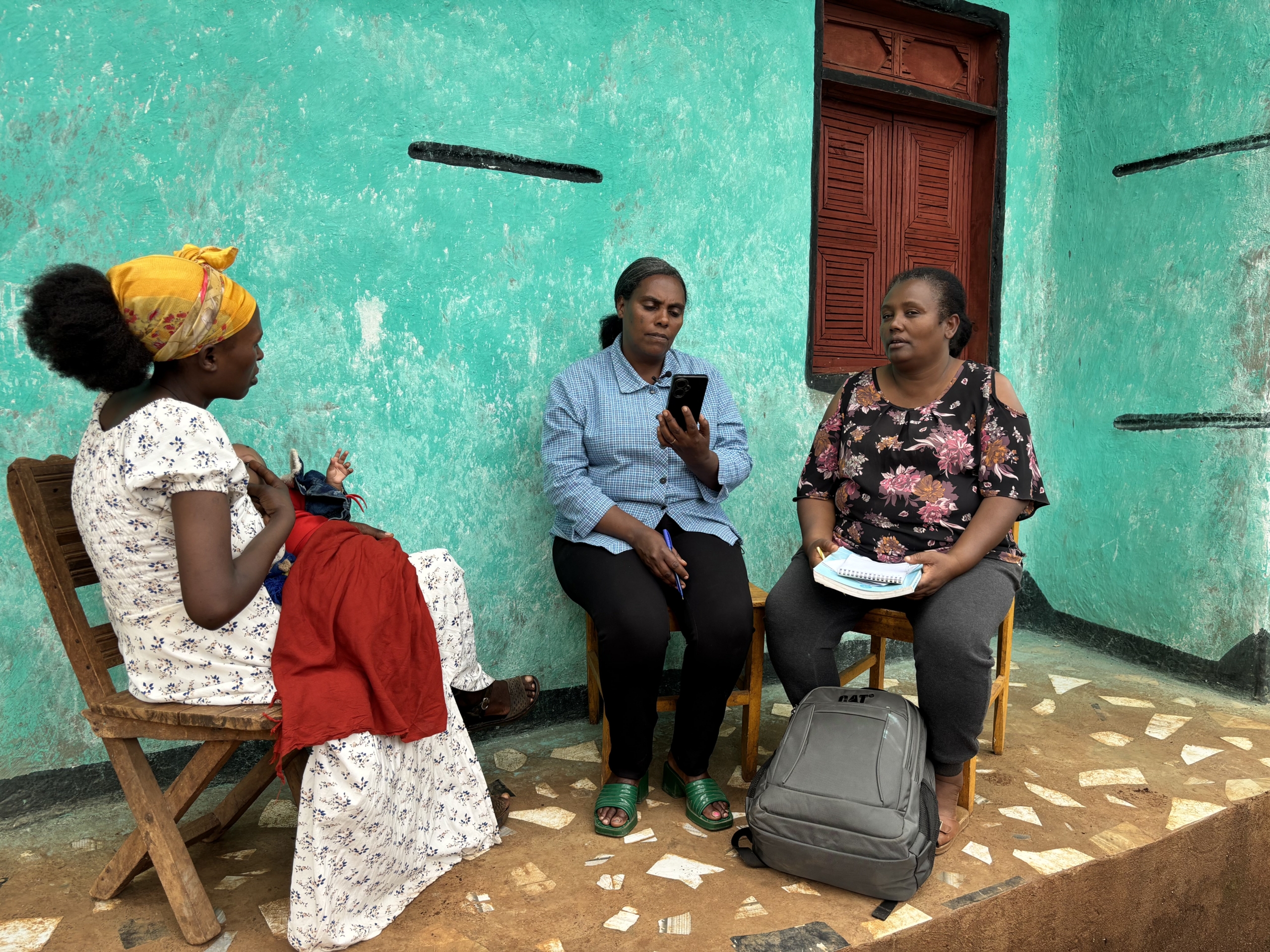
Community health worker Zinabua Moges seeks support from HEP Assist during a patient visit.
Looking forward
AI is a rapidly evolving tool that is already having a robust impact on access and equity. As we look forward, Last Mile Health is committed to building tools with and for the people they are intended to serve: the community health workers whose expertise, trusted relationships, and resiliency remain irreplaceable. Community health workers like Aynet are treating children and mothers every day, making a call on what to do next. The decisions they make—and their impact on patient outcomes—must remain the measure of everything we build.
By Lisha McCormick, Chief Executive Officer; Divya Nair, Chief Technical Officer; and Mallika Raghavan, Deputy Chief Program Officer