By Bezawit Mulugeta, Multimedia Production and Communication Coordinator, Last Mile Health Ethiopia
For millions of people in rural Ethiopia, vision is a primary tool for survival. Whether for a teacher grading exams or a mother sewing clothes for her children, sight is crucial to maintaining livelihoods.
However, at age 35, a natural change begins to occur. The lens of the eye loses its flexibility, and near vision—once sharp and vibrant—starts to blur. This is presbyopia. In many parts of the world, it’s a minor inconvenience solved by a quick trip to any supermarket. But in rural Ethiopia, where the average income is stretched to cover essentials like food and water, a pair of reading glasses is often an impossible luxury. For those who earn their living through precision or literacy, this decline in sight is a threat to survival and independence. When you cannot afford to see, you cannot afford to work.

Ramzi at work.
Seeking a formula for better vision: Ramzi’s story
This struggle was a daily reality for Ramzi Abrahim, a 36-year-old science teacher and physics student in the Harari Region. For two years, the complex formulas and calculations that defined his work became a frustrating blur, forcing him to require his students to write only in capital letters so he could grade their assignments. “If they didn’t, I would have to skip their work because I couldn’t see the small letters clearly,” he admits. Despite his dedication to education, his low salary left an impossible gap in affording eyeglasses.
In communities like Ramzi’s, community health workers—known in Ethiopia as health extension workers—are bridging this gap. Traditionally, the integrated primary care they provide has focused on maternal and child health, but a new training from Last Mile Health in partnership with Ethiopia’s Ministry of Health has equipped them to address non-communicable diseases (NCDs) as well, including screening for and addressing eye diseases and presbyopia. Through organized community campaigns, they promote screening dates and then set out to transform lives, one eye exam at a time.
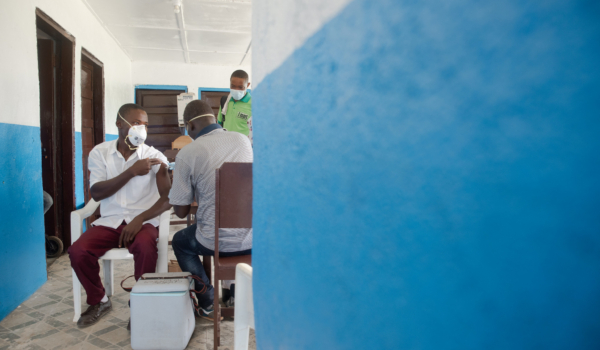
During these screenings, the service goes beyond just vision. Community health workers also measure blood pressure and blood sugar levels, providing a holistic NCD screening for conditions like hypertension and diabetes. For patients with more complex eye conditions like glaucoma, trachoma, myopia, and cataract, the community health workers provide referrals to the nearest health center for advanced treatment.
For Ramzi, this initiative was a turning point that restored both his professional authority and his own educational pursuits. “Now I can review exam answers effectively,” he says with confidence. “I can revise what I am learning in my physics studies and do my reports as department head without struggle. I can finally see clearly again.”

Mekoyet reviews patient data.
Giving and receiving care: Mekoyet’s story
The project similarly empowers those within the health system itself. Mekoyet Amare, a 40-year-old community health worker in Bahir Dar Zuria, found herself on both sides of this mission. While she served her community, she privately struggled to read the client registers and health reports required for her job. Assuming the strain was an inevitable part of getting older, her efficiency began to wane until the near-vision glasses distribution project reached her own workplace. After being screened and fitted with glasses, the change was instantaneous. “I felt like I got 10 years younger,” Mekoyet shares. “I can read like before.”
Restoring livelihoods and self-reliance: Nuria’s story
This restoration of sight ripples through every sector of rural life, from the classroom to the farm. In the Dire-Xeyara woreda, 55-year-old Nuria Duri found that her deteriorating vision was stripping away her autonomy. As a farmer, she could no longer sort high-quality grains from chaff with precision, and at the market, she lived in fear of being cheated because she could no longer distinguish the denominations of her money. Through a community screening at her local health post, Nuria received near-vision glasses that restored her ability to manage her household’s economy and food security without relying on anyone else. “Now, I can count my money and sort my grains without any help,” she says.

Nuria sorts grain, equipped with her new glasses.
Scaling impact: Community health workers deliver change
Ramzi, Mekoyet, and Nuria’s stories are part of a growing movement to restore livelihoods for rural Ethiopians. Already, community health workers have distributed more than 200,000 pairs of near-vision glasses to patients across more than 35 districts. And vision screening does more than provide glasses: it serves as a critical entry point for rural Ethiopians to access broader primary care from community health workers. For people who have been hesitant to access formal healthcare due to misconceptions or fears, a highly desired service like vision screening and eyeglasses demystifies care. It gives them the opportunity to receive additional NCD screenings, increasing demand for these services and supporting the expansion of community health workers’ role in diagnosing and treating NCDs more broadly: an area of substantial and growing need in Ethiopia and beyond. Vision care and additional NCD screening opens the door for patients and their families to connect to services ranging from antenatal care and childhood immunizations, to environmental health and hygiene education, to treatment for communicable diseases. By removing the financial and geographical barriers to care—for presbyopia and for the full package of essential primary health services community health workers can diagnose, treat, and refer—the project is strengthening the fabric of the community, ensuring everyone can see their path forward.