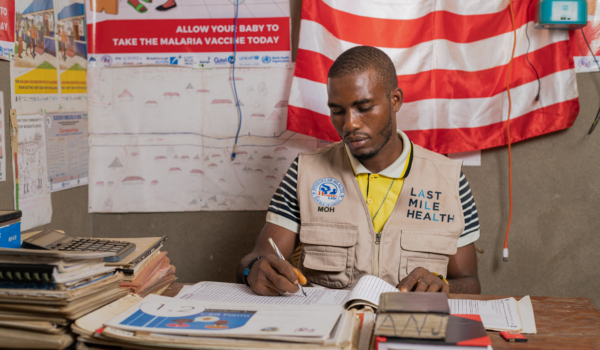
Enter community health worker Amos Jacob’s home in Mama Benson, Liberia, and you’ll think you’ve stepped into a health post. In a sunlit corner, Amos has stacked record books and training materials neatly on his desk. Behind it, health education posters surround a Liberian flag. You’ll see a map of the community, infographics promoting exclusive breastfeeding, and a bright new illustration that shows mothers waiting in line with their children while a nurse vaccinates a baby. Allow your baby to take the malaria vaccine today, it reads.
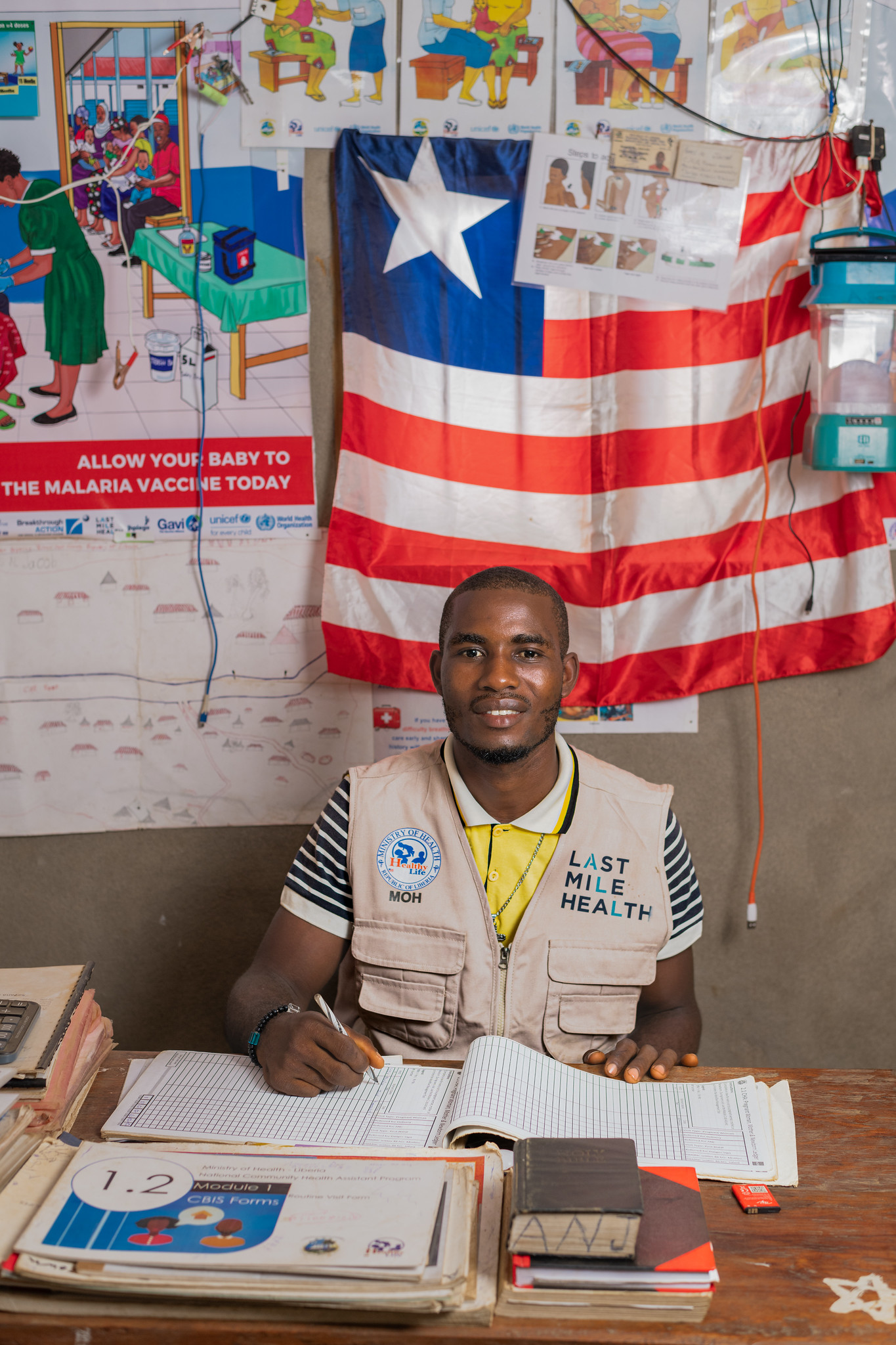
Amos works in his home office.
In Liberia, malaria is the leading cause of death for children under five. “Before we had a community health worker here, when our children got sick, for them to go to the clinic, it was difficult,” Amos recalls. “When children came down with malaria, sometimes the parents would not be able to go there due to transportation—sometimes you will not be able to walk all the way. Then, sometimes when you would go, they would say ‘No medicine.’ They would tell you, ‘Oh, go and buy tablets,’ but sometimes you wouldn’t have the money to buy the tablets, and the sickness would get worse.”
Amos, who has children of his own, is passionate about ensuring no child goes without care. Ten years ago, when the National Community Health Program began recruiting community health workers in Rivercess County, he was eager to apply. He passed his interview, completed training, and began delivering care to his neighbors, providing an integrated package of primary health services with a focus on maternal and child health. Shortly after, he set up his home office as a safe place for patients who wanted more privacy for sensitive conversations. It’s also the place where he stores the medication he uses to treat illnesses like malaria.
“When I went for the malaria training, we learned how the mosquito causes the sickness,” Amos recalls. “I am always giving health talks, counseling children how to take care of themselves, and I encourage the people to sleep under the mosquito nets every day and they’re doing it, so it’s harder for them to come down with malaria.”
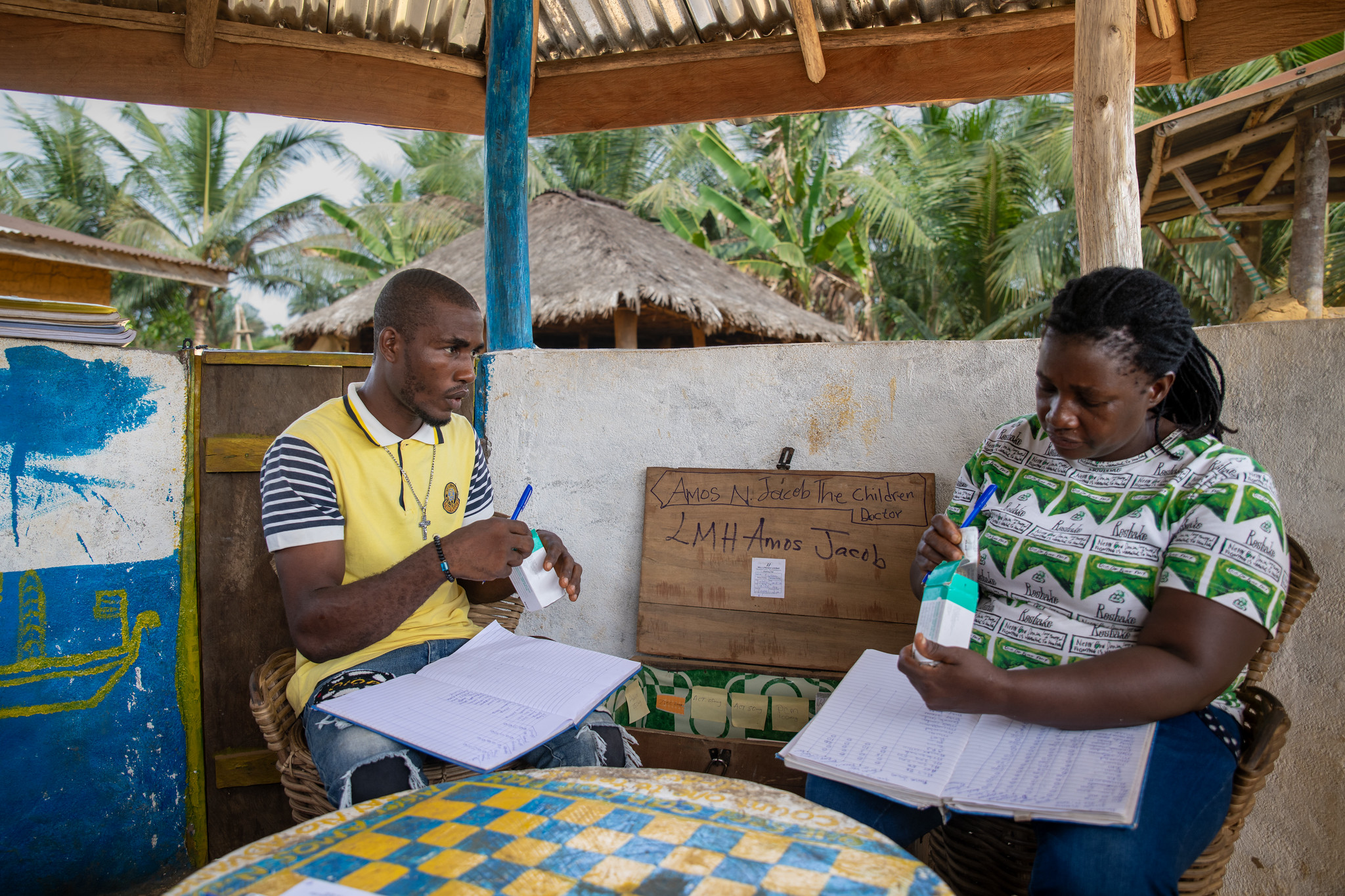
Amos meets with his supervisor, Theresa Mah.
The health education and awareness Amos shares, coupled with long-lasting insecticide treated nets, has helped reduce cases of malaria in his community—and when children do show symptoms of the disease, they no longer have to face the barrier of distance and cost to access treatment. “As soon as their child gets sick, they bring them here,” he says, gesturing to his office. “Sometimes if I go for routine visits, if I find the child sick, I treat them there at home.” If he observes fever and vomiting, he conducts a rapid diagnostic test to screen for malaria. When children test positive, he treats them immediately and at no cost, administering Artemisinin-based combination therapy for malaria and paracetamol for fever. For more severe cases, he refers them to the health facility, working with his supervisor, Teresa Mah.
Despite the positive change, malaria has remained a serious concern for families in Mama Benson. So in 2024, when Amos learned about a new vaccine that would help reduce the severity of cases, reduce hospitalizations, and prevent deaths, he was eager to help bring it to his community. He received training from Last Mile Health and the Ministry of Health, learning how community health workers would serve as a crucial component in rolling out the vaccine as part of the routine childhood immunization package. Today, Amos provides community education, helping families understand the importance of the vaccine and connecting them with in-community vaccination dates. He then follows up with parents and his supervisor, helping track each child to ensure they receive all four doses.
“The malaria cases were higher before the vaccine came,” Amos shares. “I’m seeing a great change. And the change is our children are not getting sick like before.”

Amos prepares to conduct patient visits.
Amos has big dreams for himself, his family, and his community. He wants to continue his education, support his children’s education, and ensure everyone in Mama Benson can access and afford healthcare. His role as a community health worker is helping him realize these dreams: his salary supplements the income he earns as a farmer, allowing him to put money toward his children’s school fees and, he hopes, return for further schooling himself someday. And his daily work is changing health outcomes: “As a community health worker, we serve as a bridge between the community and the facility,” he says. When the Ministry of Health gets new information, he explains, “They pass it on to us, and we give the information to our communities. For that reason, it was important for me to go and attend the malaria vaccine training. When I left from there, I went to my people and I explained the importance of the malaria vaccine to them. Once I gave them the information, they were happy to take the vaccine. They know somebody from their community went to learn about it, so they were encouraged.”
For now, Amos is focused on helping every child in Mama Benson live a healthy life. “When your child is sick, you will not be able to earn money, because you will not be able to leave that sick child home. Your child will not be able to go to school. But if your child isn’t sick, everybody will be happy,” he says. “Once there is healthy life, it will be happiness there.”